Chiropractic For Neck Pain St Ives
Persistent stiffness and pain are not normal while it is extremely common. Dr Ben explains the why behind your recurring neck pain and discomfort.
Oct 17, 2026
Neck Pain
Why Does Neck Pain Keep Coming Back? (It’s Not Just Your Pillow)
Neck pain is one of the most common complaints we see at our St Ives clinic. Modern routines demand hours at a desk, lack of varied physical activities, higher daily stress, and endless screen time.
Most people blame a "bad pillow," poor posture, or an awkward sleeping position. While those factors don't help, they rarely explain why stiffness lingers or flares up again and again.
To understand why neck pain persists, we have to look at how the brain actually balances your head—and why it hits the "brakes."
An Engineering Marvel: Mobility vs. Stability
Your neck (the cervical spine) is the most flexible part of your entire spine. It is built to keep your eyes level with the horizon, balance the weight of your head (around 5 kg), and free up your hands and eyes for daily tasks.
A healthy neck has a surprising amount of movement:
Looking down (Flexion): 45° to 50°
Looking up (Extension): 60° to 75°
Tilting ear-to-shoulder (Lateral Flexion): 40° to 45° each way
Turning left and right (Rotation): 70° to 85° each way (nearly 180° total!)
Because the neck is designed to be so mobile, the bones alone cannot keep it stable. That stability relies entirely on dozens of small, finely tuned muscles working together in real time.
The Brain’s "Internal GPS"
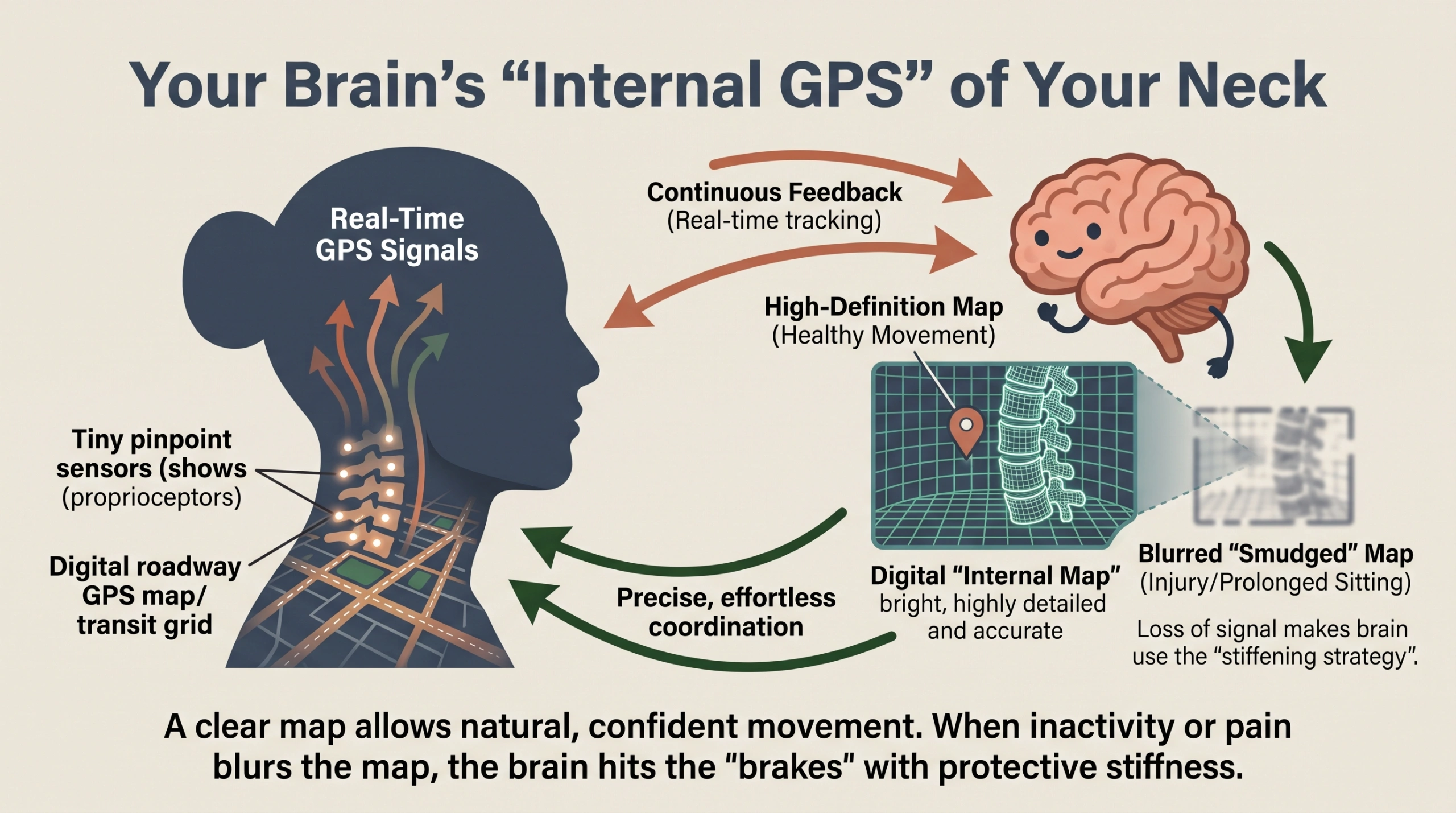
To keep your head steady without straining joints, your brain relies on a high-definition internal map of your neck.
Deep inside the small muscles and ligaments around each vertebra are microscopic movement sensors (proprioceptors).Every time you turn, nod, or tilt your head, these sensors beam real-time coordinates back to the brain.
When this feedback loop is running smoothly, the brain orchestrates effortless movement: deep stabilizing muscles fire with millisecond timing, loads distribute evenly, and you feel light, stable, and pain-free.
The Driving in the Fog Analogy: Why Stiffness Happens
What happens when you spend years sitting still, looking at screens, or recovering from an old neck strain?
Without regular, varied movement, those deep sensors go quiet. The brain stops receiving high-resolution feedback, and its internal map becomes blurred or "smudged."
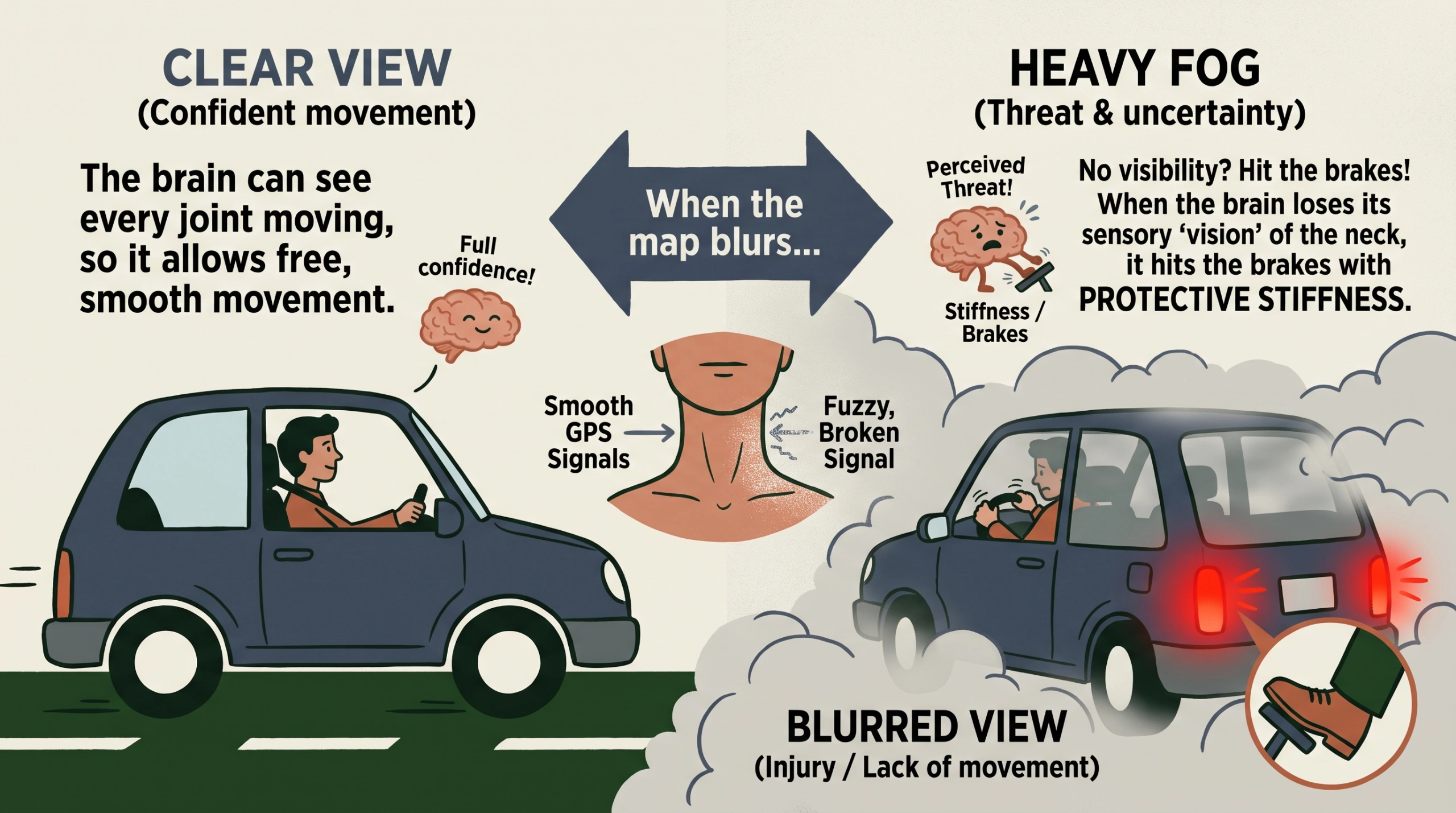
Think of it like driving on a highway during a sudden, heavy downpour:
When your windshield is clear, you drive smoothly and confidently.
When fog rolls in and visibility drops, what do you do? You tap the brakes and grip the wheel tightly.
Your brain does the exact same thing. When it loses clear visibility over where each joint is in space, it perceives vulnerability. To keep you safe, it deploys a protective stiffening strategy—locking down surrounding muscles to stop you from moving into ranges it can no longer accurately track.
The Self-Perpetuating Cycle of Chronic Neck Pain
Stiffness is rarely just tight muscle tissue; it is an active safety decision made by your nervous system.
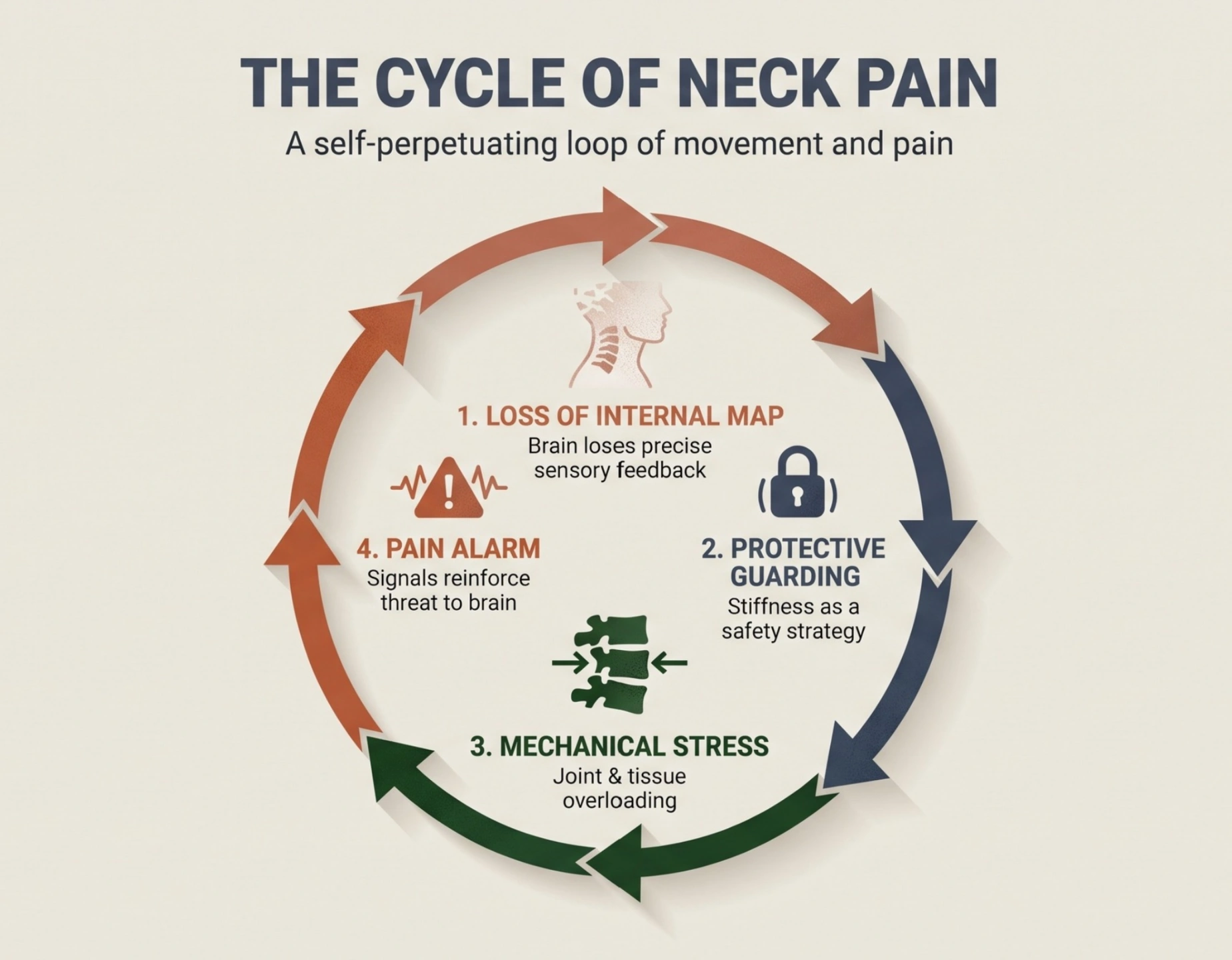
The problem is that this protective response quickly creates a closed loop:
Sensory Smudging: Lack of varied movement blurs the brain's internal map.
Protective Guarding: The brain stiffens neck muscles to create artificial stability.
Mechanical Overloading: Because the neck moves like a rigid block instead of smooth individual segments, daily loads concentrate heavily on specific joints and discs.
Pain Alarm: Overloaded tissues send warning signals to the brain.
The Loop Tightens: The brain interprets these pain signals as further proof of danger, tightening the muscles even more and reducing joint movement further.
Breaking the Cycle
If you only treat the symptom by rubbing or stretching a tight muscle, the brain will often tighten it right back up within hours—because it still feels unsafe.
True recovery requires addressing the root cause:
Calming the threat response so the nervous system feels safe releasing its protective grip.
Restoring segmental joint movement through targeted clinical care.
Re-mapping the neck with active motor-control retraining, teaching the brain to trust movement again.
When the brain's windshield clears, it no longer needs to ride the brakes.
Dealing with persistent neck stiffness or recurring headaches?
Our team at Shalom Rehab Chiropractic in St Ives uses evidence-based assessment and active motor-control retraining to address the mechanical and neurological drivers behind chronic spinal pain. Book an initial assessment online or get in touch with our clinic today.